Thursday, December 10, 2009

Blog 7 Engaged Citizenship

Hollihan writes, “Political communication is therefore the means by which people express both their unity and their differences” (Hollihan, p.10). Political communication plays a large role in how we interact with one another, and often times can be the bases for what we chose to say or not say. It’s the language used that gives voice to our political messages and opinions. For me, political communication is something I usually try to avoid. I am a person who struggles when it comes to the topic of politics, and although I am a registered voter, I have a hard time making my own opinion regarding certain political issues. It wasn’t until the 2008 election that I began getting more interested in the topic, and forming my own opinions about the policies and presidential candidates. I felt like I was accomplishing something and playing a role in our society, my only regret is that I should have played that role sooner than at the age of twenty-one. Looking back on my experiences and education, I have a hard time remembering specific events/classes contributed my knowledge of politics. Members of my family have strong political opinions, but when it was the topic of conversation I felt not smart enough to participate. I came into this class, political communication, with the goal of not only improving my knowledge of politics, but also to give me more confidence to discuss politics with others, even if that means just asking questions to better my understanding. Now that the class has come to an end I feel like I accomplished just that. I have more confidence mostly because I have learned that I am not the only one that struggles when it comes to politics.

While I am happy that this class helped me improve my political communication skills, I still feel like there needs to be something done in order to obtain those skills at an earlier age. The interpersonal, public, and cultural levels concerning political communication are all open for improvement. One main area that needs improvement is the education of politics on both the public and interpersonal level. In my early years of schools politics was never the topic of conversation; instead the curriculum only covered history, math, science etc. While all these subjects are important, it seems as though one major subject was missing, politics. In order to improve political communication, it needs to be talked about with students at a young age. It would be very beneficial to have classes that only deal with politics, and how our government is run, and what Is being discussed and debated at that moment in time. These courses could also touch on different policies and why they play a large role in determining which presidential candidate the voter vote for. At a more interpersonal level, it would be beneficial to not only teach the basics of politics, but encourage the discussion of politics. Sitting in circles and having kids discuss why they believe want they believe or allow them the opportunity to ask question. This kind of group discussion in the early years of schooling will not only improve their communication skills, but also improve their ability to discuss politics. Many reason of why people don’t talk politics at a later age are due to lack of knowledge, fear of not being respected, thinking its boring or irrelevant, or even polarization. Having the education of politics and group discussions offered at a younger age level will avoid these preconceived notions of talking politics, and will result in an increase of interest and understanding of why political engagement is so important.

Another area of improvement is the media. Often times our mind can be skewed by what is said in the media, especially when it comes to politics. We fall into the trap of the media and throw our own opinions out the door. The media distracts us of what is important and as we have learned in class, becomes a reality show digging up scandals and controversy, the politicians embroiled in a daily narrative, and voters believing everything they hear. An approach to improving politics in the media is to avoid these minor of false details. During the time of an election the media can often get lost in the minor details, and can forget to discuss the important things. We hear the negatives about the presidential candidates regarding their personal lives or their past. Instead the media needs to focus on the now, and the truths. The individual attacks needs to be taken out and instead focus on the policy of each candidate, along with their plans to better our nation. As discussed above, education needs to be improved, being that media provides us with education it to need to improve. Many voters get their information from what is said in the media. If irrelevant facts having to do with the candidates are what are being discussed, then voters will begin basing their decision off of the wrong information that really has nothing to do with politics or why a candidate would make a good president. In order to have effective political communication people need to be aware of what is going on. In order to improve their awareness, the media needs eliminate the irrelevant aspects and draw voter’s attention to what is important.

With the improvement of education, knowledge, and media comes improvement of politicians and voting system. The politicians can’t always control what people are going to say about them, or what voters think, but they can influence our opinion. Politicians can improve political communication by being open to the public and focusing on the positives rather than negatives of their opponents. When I listen to a presidential candidate speak, I don’t want to hear him/her use their opponents name over and over again, but instead talk about what they are going to do, what their policies are, and encourage voters that in order to better our country, the need to be president. This will allow the voters to make their decision based on the important facts and will result in a better voter turnout. The voting system can improve by taking the presidential candidates off the ballet, and instead just have the policies. We vote on the policies we agree with and the presidential candidate with the most votes on their policies with become president. Improving what is on the ballets will require voters to become knowledgeable of the policies instead of just voting based on a popularity test.

Interpersonal, cultural, and public levels of politics all play large roles in how we use political communication. If we don’t increase the awareness, knowledge, and education on all these levels politics as a whole will become less and less important within our society. We need to keep improving political communication and teaching so that voter turnout stays high, and so that the topic of politics remains a priority to all.

Education. Knowledge. Political Engagement

When I first came into my Political Communication class (SPCM 420) I was not comfortable with the political sphere what so ever. I did not feel comfortable talking about my views, asking people their stance on political issues, challenging people and their frame of reference, or even participating in political discussion at all. I would simply remove myself from the situation. After talking about several different aspects of politics and how the political sphere has evolved and transpired over the history of our country, I have gained some background information helping me to feel more connected and involved with the political sphere. I was not educated about the political system and therefore did not care or feel like I mattered in politics. I realized that I was not interested because I was not educated on the basics. I think education, knowledge and understanding open up a lot of doors for people to gain interest and concern in a specific matter. Without education there is ignorance and through ignorance we create tension. Education is something that is needed in the curriculum of junior high and high school level classes in order to have more engaged citizens. Educating the youth for their future involvement with the political sphere and connecting them to politics may spark an interest in being involved but solely prepare them to be an adult in our country. If education about politics, political rhetoric and critical thinking is given to the youth of America before they become adults in the real world, we could have higher expectations for engaged citizens, thus creating higher expectations for our politicians for the future of our country.

For politics, there is no structured class or time where young American citizens get a clear description of the layout of the political system. There is no time where we learn why things are the way they are and how they came to be and how to critically analyze politics. When it comes to political rhetoric and religion (two things that highly influence the decisions that Americans make) without the skills to critical analyze them, citizens can fall down the path of poor decision-making. Things they did not even realize were influencing their perspective could sway them one-way or the other unconsciously. Creating savvy political consumers, the political sphere can be more engaging and possibly even more genuine. Americans can vote at age 18 but do we know what is truly going on in the world and the political sphere for that matter at that age?? I did not. I did not until this course taken at Colorado State University.

Falling for catchy tunes or following a candidate because your favorite celebrity endorses them is not a reason to vote for a Presidential candidate or any political figure. Granted, we are a democracy and voting is our individual right but without proper knowledge of what you are voting for, we can potentially damage the freedom that this country stands for. We need to be savvy, conscious, aware, engaged, concerned citizens when it comes to politics. I am not saying everyone needs to love everything about the political sphere and watch the news all day and research politics 24/7 but I do think a little education on the history of politics, political satire, political advertising and rhetoric are necessary things for a citizens to fully engage. Without this knowledge the basis of our understanding could be skewed and lead to higher misunderstandings and poor judgment.

Knowledge of politics will entice people to continue involvement in the political sphere. I know that personally, after having a better understanding of even what is going on in the political sphere, I want to be more active and engaged even if it is just a discussion or a challenge of someone’s personal view. I want to be a part and give my two cents in challenging the opinions of others with attempt to create a deeper understanding within myself for what I truly believe in and how I truly feel. Education is key. If we expect 18 year olds to be able to vote, they should expect to be educated on how to analyze political issues and how to involve themselves comfortably in the political sphere. Education can help raise the standards for both engaged American citizens and the politicians of America.

With education starting at a younger age and having it set in the curriculum so all youth are relatively on the same page, politicians and media will not be able to trick us, if you will, into falling for things that may or may not be relevant to the campaign. Savvy Americans will not fall for the attack ads, or the irrelevant rumors (Obama and Muslim rumors) or the criticism on inappropriate items (Sarah Palin’s wardrobe). We would be held responsible for recognizing that things should not influence how we feel about political entities. However, they can influence how engaged citizens feel about a particular person or candidate as long as they are aware of that influence and are comfortable with that. Being a democracy we all have to work together and if people are not making educated decisions and just making them because they can, we have potential to not remain a democracy forever. We need to be cautious citizens, aware of what the government is doing so we can keep the history of our country.

Also with education, citizens can become savvy media consumers. Media plays a big role at times when it comes to politics. It is how we receive our political information for the most part. It is rare that Americans get to hear a speech first hand or be around when the Democratic or Republican convention takes place. We depend on media to deliver our political news. If we do not understand media biases or seek out objective news resources, we can potentially become puppets to the media and essentially lose our right to freedom.

If we have more educated voters and engaged citizens, higher expectations and responsibility will be placed on every party in the political sphere. Voters will be held to higher standards in that they are expected to be aware of political issues and concerned with the future of our country where they actively participate themselves. With educated voters we will set higher expectations for political candidates to be more genuine and qualified for the position of running our Country/State/City and what have you. They will not be able to “play” us and will have to find ways to win our vote by focusing on political issues that will help better our society. They will not be distracted with making the other party look bad or creating an attacking or defensive advertisement. They will focus on what they can truly do to achieve what the voters want from them as a leader. With more educated voters, Media will have to focus on more issue based news coverage as well. Educated, aware and concerned voters will not be interested when the president goes to the beach and how nice he looked taking a jog with his wife. We will want issue-based news coverage. What the political candidates are doing to help the greater good. What new policies are the candidates thinking about or wanting to implement in the future and what those policies will do for our economy. We will not want to be distracted with irrelevant news because we will be provided with news that will help us make educated decisions about our political candidates. We will seek out to savvy political consumers.

Education in our youth can prospectively change the future of America. Citizens might possibly be more engaged in the political sphere, which has the capability to change how the media displays politics and how political candidates approach the role of leadership in America. Education can actually make a change. It can make a change for the better and help Americans in being more patriotic while having faith in the government. Education is key to success.

Thursday, November 19, 2009

Presidential Debates Influence

“Debate or debating is a formal method of interactive and representational argument. Debate is a broader form of argument than logical argument, which only examine the consistency from axiom, and factual argument, which only examine what is or isn't the case or rhetoric which is technique of persuasion” (Wikipedia.com).
Since the 1976 general election, debates between presidential candidates have been a part of U.S. presidential campaigns (Wikipedia.com). Candidates debate several times during campaigns and viewers tune in on a regular basis to gain understanding of politicians views. According to Hollihan, “watching presidential debates can influence the perceived importance of decision factors (policy, leadership) as well as the importance of specific issues. Watching a debate can alter impressions of which candidate is most desirable on the issues and how the candidates rate on character traits. Furthermore, watching a debate can increase voters’ confidence in their vote choice” (230). These televised debates clearly have an effect on the audience’s views but should they be so influential? Are we, the viewers, making accurate assumptions based on the way candidates carry themselves and how they look on Television? Televised debates are highly influential in voter patterns in America but policies, qualifications and views on political issues should be more of the focus for Presidential candidates rather than their appearance on TV.
Election campaigns are key moments in democratic democracies because they allow citizens to hear different political viewpoints and make the right choice in voting for a candidate that will best represent their needs. Two important predictors of how people will vote are their positions on issues and candidate images. The image-only school predicts that audiences will receive little gain in issue knowledge after a debate but they will be impacted greatly by the candidates’ images. Even though television conveys both verbal and visual messages, it essentially is a visual message medium requiring less involvement by audiences to process the message than that of processing messages in print media (Graber, 1987). (Read more at http://www.associatedcontent.com/article/54720/televised_presidential_debates_and_pg2_pg2.html?cat=37 )
We saw several things in class that reinforce the idea that both verbal and visual messages are conveyed through presidential debates. We discussed George Bush and how he was caught looking at his watch a few times and John McCain criticized for walking around the town hall when in reality he could not reach the chair. It is sad that the fact that George Bush looked at his watch potentially affected his campaign for Presidency. I understand that it makes him look like he has better things to be doing and is not totally concerned with the debate but if his politics are more beneficial for the future of our country, he looking at his watch should not have such a large impact on the campaign. John McCain walked around the town halls a lot and looked like he was just floating around the room. Granted, it was funny (especially the clip where they show him just walking around in front of Obama while he is speaking). These little things shape the image of the candidates for the viewers during these debates. Is that right? Should we allow the media to create our reality and our perspective of candidates with something so important as the President of the United States?
We also talked about different formats for presidential debates. There is the panel of questioners where experienced questioners cover a range of topics. Single moderator format is where a moderator covers a range of topics and referees the discussion. The town hall forum is where citizens get to write and ask questions while a moderator facilitates the format. The roundtable discussion allows for more interaction between candidate with free reign to talk about what they want to and elaborate as much as they feel need. As we saw in class, this can go wrong pretty quickly. Bush and McCain went on a tangent about dirty campaign advertisements in South Carolina for about 15 minutes. The last debate format we talked about was the LIVE hybrid CNN/YouTube debates in the 2008 primary.
The LIVE hybrid debate format could be extremely beneficial in the future of political debate forums. Once all the kinks are out this form of debate can be revolutionary for American politics. People from all over the Country and world even can participate in this type of debate format and more voices can be heard, acknowledged and possibly answered. Anderson Cooper did a great job at attempting to make this work, especially with all the funny inserts here and there of the candidates. It made it a little less structured and made the candidates look like real people instead of political robots. If they took the time to really develop a way to make this format work, I think the future of politics has potential to be more of an interest for more Americans. I know that I watched this debate the whole way through when during other debates this past election, I would change the channel after it got boring or redundant. If people of different cultural background, class and region had the opportunity to participate in the debate format (like in the Hybrid format) they also have the opportunity to be more knowledgeable on the subject and have a deeper interest and concern.
I talk to some people about politics and so often I hear that they do not have an interest because they feel like they do not play a role in the political sphere. It is somewhat true to an extent. If we are not actively participating in something it is hard to feel like you really affect the outcome. Considering that debates truly influence the outcome and views of the candidates, the Hybrid format can help out the candidates and the people viewing as well.
Debates that are televised help the viewers relate to the candidates and decide who they agree most with. They are extremely influential for the candidate’s image and campaign for presidency. The way they look and carry themselves on television highly impacts the outcome of the campaign. We should be savvy media consumers and recognize that things that influence our views of these candidates should have to do with their qualifications as a President, their politics and the ability to better the future of our country. We need to not focus or overwhelm ourselves with how well their makeup is done or anything that has to do with looking good on television. We are a beauty obsessed country and there is a need to focus on the important things when it comes to politics and the prospect of our country.

Tuesday, November 10, 2009

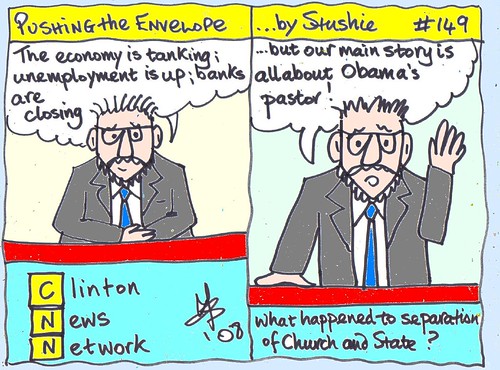
Separation of Church and State? Hardly

The constitution states, "Congress shall make no law respecting an establishment of religion, or prohibiting the free exercise thereof."(http://www.allabouthistory.org/separation-of-church-and-state.htm)

The more common translation of this phrase is there should always be a “separation between church and state.” History proves that Religion has always played a large role in the political sphere. America has almost always had a Christian as a President and that is not a coincidence. We as American citizens can claim that there is a separation between the two but clearly there is not a distinct separation. The line between the two has become blurred and religion has inherently become a societal factor in America. Religion has been an influence on American’s when it comes to Presidential candidates, Stem-Cell research, abortion issues, and same sex marriage laws. These policies are a part of our national politics and with the blurred line of church and state, we have developed some dilemmas in our political sphere.

In regards to the recent election, Obama had several issues around his religious orientation that lead to other harsh allegations. "I've been to the same church, the same Christian church, for almost 20 years," Obama said, according to MSNBC on January 21, 2008. "I was sworn in with my hand on the family Bible. Whenever I'm in the United States Senate, I pledge allegiance to the flag of the United States of America. So if you get some silly e-mail ... send it back to whoever sent it and tell them this is all crazy. Educate."

Bashing Obama

Barrack Obama had to make some corrections during his campaign in 2008 against the allegations that he was a Muslim terrorist in disguise. There was a popular mass email going around about Obama being a Muslim terrorist and swore in to the Senate on the Quran and turns his back on the flag during the pledge of allegiance. This was a concern wrapped into the 9/11 terrorists attacks in New York City connecting Obama with the attack. (Read more at http://www.msnbc.msn.com/id/22767392/).

To be quite honest, I received several of these emails during the 2008 campaign from a variety of people. Political Rhetoric played a big role in these emails on Obama bashing; “terrorist”, “anti American”, “Muslim”… terms a Presidential Candidate does not want to see written or spoken about him. Additionally, these terms evoked fear in some Americans about the religious orientation of Obama. These allegations set Obama back for some time, having to call upon his pastor of 20 years to support him to get back on track of addressing his actual politics, which in return ended up being another issue in itself as we all remember I am sure.

Religion also played a large role in the deciding factor on Stem-Cell research in America. According to Pew Research in 2005, roughly half (52%) of opponents to Stem-Cell research say their religious beliefs are the biggest influence on their thinking, while 13% cite what they have seen or read in the media and 12% mention their education. This is proof that religion, whether we try to deny it or not, plays a huge role in people’s thoughts and concern about politics and the way of life in our country. The Pew Research also stated that, “Conservative Republican opponents are especially likely (70%) to cite religion as their main influence, as are evangelical Protestant opponents (69%).” However, on the other hand of this survey, “31% of supporters for Stem-Cell research say the biggest influence on their thinking is the media, and 28% mention their education. Just 7% say religion is the most important influence. College graduates (44%) who favor the research are particularly likely to name education as their primary influence, as are pro-research liberal Democrats (43%).” Religion plays a role in both sides, more so in the opposition of these politics but nonetheless, religion still remains to be a deciding factor for some Americans in political views. With the blurred separation of church and state, people’s religious beliefs have continuously affected their views on political matters (Read more at: http://pewforum.org/docs/?DocID=145).

When it comes to the abortion debate, due to “separation of church and state” the United States Government has not been able to make abortions illegal or legal due to religious interference. It has been such a huge debate because it’s not only religious factors that influences peoples’ beliefs but morality and practically plays a part as well. Ethics and morality inevitably relate, in some form, back to religion and upbringing, therefore, religion will have some influence on the issue. When people think morally about the issue of abortion, I am sure no one would condone “killing” and essentially that is what abortions are thought to do. Granted, there are many factors that go along with that but in the broad scheme of things, morally, that is the issue behind abortion. Other moral issues that go along with abortion include: Is it moral to kill a baby for the sake of the mother’s life? Is it moral to kill a baby after rape? Does an unborn fetus have rights? Is an unborn fetus considered a living creature? These are all moral questions that people find hard to answer. American government could not possibly answer these questions for citizens either, hence the morality dilemma. Morality is not something that has a strict definition; to each their own. Morality relates back to religion and with religion being an influence, this is another example of how religion and state/federal laws are not entirely disconnected.

Another huge issue recently in America is the debate over legalizing same sex marriage. The biggest counter arguments that I have come across in my research in my past years in college regarding same sex marriage has been the issue of marriage being “sacred” and “traditional”, that same sex marriage is “against God’s will”, and “God intended marriage to be for procreation.” The only factors and counter arguments against legalizing same sex marriage has to do with “God’s plan,” thus referring back to religion. On the flip side, no government has suggested that any religious groups be forced to perform and recognize gay marriages and that proves that the government attempts to create a line between the two. However, there are obviously some conflicting views about legalizing same sex marriage on the basis of religious views and that is not supporting the “separation of church and state.”

If the “separation of church and state” means anything, it must include the idea that people cannot be forced by the government to live according to the commands of others’ religion. Issues such as what religious upbringing a Presidential candidate has, whether stem-cell research should be allowed or not, whether abortion should be illegal or legal, or whether people of the same sex should be able to join in the commitment of matrimony, clearly draw on religious beliefs. In actuality, according to the Constitution, religion and church teachings should not even play a factor in the judicial system. The blur between the two, church and state, has developed several predicaments in regards to making laws. The government system will continue to reach impasses until the fine line between church and state is noticeably established. Evidently, the separation of church and state is not an exact disconnect because one way or another, religion will influence the views of American citizens.

Tuesday, October 27, 2009

Late Night Talk Shows and the Internet Take Over Political Campaigns... For the Better

“It’s like they handed over the reins of commentary and reporting to comedians because we are the only ones that can makes sense of it; because out currency is one of insanity.” Madeleine Smithberg, co executive producer of The Daily Show.

In chapter five of Entertaining Politics, Jones starts off his section with this quote about politics and popular culture. He stated that the Pew Research Center in 2000 reported that 47 percent of people under the age of 30 got some information about the Presidential Campaign from late night talk shows. Furthermore, the internet has now become a leading source of campaign news for young people. According to 2008 Pew Research, the role of social networking sites such as MySpace and Facebook are playing a role in the information collecting of political news. Is collecting information from sites such as Facebook and shows like The Daily Show with Jon Stewart bad for the outcome of Presidential campaigns? Are people receieving credible information? I think so.

Late night shows are still places where people find information about candidates and political issues. The Daily Show with Jon Stewart on Comedy Central is a show that addresses issues and things of political interest but in a different way. The younger generations are savvier on recognizing news biases, media framing and intentional political rhetoric. I believe that that has a huge effect on why people are relying more on political satire to gain political information. Yes, Jon Stewart clearly is a “fake” news show but he still reports on real life events… for the most part. People that watch his show are most likely up to date with politics and political issues or they would not find his humor that funny in the first place. Therefore, he can play on real news, assuming the audience will catch on for a laugh.

I do not see a problem with people watching The Daily Show and learning political information that way. I think Jon brings things to the viewer’s attention on purpose because a lot of it has to do with the media framing of a political candidate or just merely bias opinions. News is not always objective and Jon makes this clear by mocking the biased reports. He takes away the biases and the viewer is able to see the raw material; the true issue of the matter, whatever that may be. According to Jones, he is “speaking common sense through a common vernacular about politics yet retaining uncommon knowledge of trivial or arcane cultural references; being both a cynic and an idealist.” He attempts to offer insight and clarity and with laughs and jokes aside, that is exactly what late night entertainment television does. When media, the government and other outlets fail to offer understanding, the political comedy gives a common knowledge and familiarity to viewers that had before not been given the opportunity to comprehend. They provoke viewers to be savvy in viewing mainstream media and encourage them to be involved in something that may not spark an interest in them until they can laugh at the hypocrisy and idiocy of politicians and those in the spotlight.

Similar to late night television, the internet has a rise of attention for finding campaign information. According to2008 Pew Research, 42 percent of those aged 18 to 29 say they regularly learn about the campaign from the internet, the highest percentage for any news source. In the research taken in 2004 by Pew, only 20 percent of young people said they routinely got campaign news from the internet. It has aggressively increased with the knowledge and accessibility of computers. “Were it not for the Internet, Barack Obama would not be president. Were it not for the Internet, Barack Obama would not have been the nominee,” said Arianna Huffington, editor in chief of The Huffington Post. That is weird to hear. Our President now may not have even been recognized or glorified the way he was had it not be to the increase of use in the internet in politics.

Not only is the internet just easier information to attain usually, it is cheaper for campaigning and getting the politics out there. Clair Cain Miller for the New York Times said that Obama used free advertising on YouTube to his advantage. “The campaign’s official stuff they created for YouTube was watched for 14.5 million hours,” Mr. Trippi (who ran the 2004 campaign) said. “To buy 14.5 million hours on broadcast TV is $47 million.” On television, advertising can sometimes be overwhelming, as we have previously discussed about attack ads and such. With the internet, people can look for these advertisements, watch them over and over if they want to and create a thorough opinion, critique of admiration for the ad or the candidate. Internet is something that advertising is a part of but not only that, people who just usually watch television can actively participate in discussions and critiques. It is not just 5 major corporations in television ruling over what is seen and heard by viewers, it’s those viewers keenly viewing and deliberating with peers with what is happening in the political sphere.

I think internet research can be helpful and beneficial because people can look at several different perspectives of a candidate and their views. The Internet has readily available information from BBC news, National Public Radio, and a variety of news organizations. People can look at specific issues or get a broad range of views on particular political issues. It is harder to do so with television and it is less time consuming over the internet. You get what you want, when you want it (as long as you know what you are doing). Different perspectives are given, not only from the media representatives on the sites but from the feedback given if there is an option to do so. With television, unless you are with a group of people who are interested in the topic when you see something, it is harder to talk about ideas and opinions of politics. With internet it is easier to have open discussion. I noticed that Twitter was a popular internet site this past campaign for people to debate about politicians and political interests. I think that is great because I know that myself, I am not courageous enough to always discuss politics face to face and the internet creates a comfortable medium for debate.

The Internet also allows people to develop their own opinion and blog about it, creating dialogue about the issue and learning more about either their own position or the position of another person and why. It allows for a safe space of discussion for those questioning things or just looking for answers. It is an easily accessible medium for debate or just mere information. Late night talk shows, although they mock politics at times and laugh at the hypocrisy in the political world, create a basis of understanding and common knowledge of unclear issues. The media framing of the issue is eliminated and made fun of and the raw material of the matter is exposed. People can more easily identify with what is what and question what is not and develop a sense of what it should be.

Works Cited

Miller, Claire. How Obama’s Internet Campaign Changed Politics. New York Times. 7 November 2008. http://bits.blogs.nytimes.com/2008/11/07/how-obamas-internet-campaign-changed-politics/

“The Internet's Broader Role in Campaign 2008.” Pew Research Center for the People & the Press. January 11, 2008. http://pewresearch.org/pubs/689/the-internets-broader-role-in-campaign-2008

Tuesday, October 13, 2009

Attacking can be Considered Appealing??

“Attack”: Assault; Harass; to show aggression; to use violence; Cruel; Malicious; Vindictive. These are all synonyms of the word “attack.” These words are not words that most people probably like. Most people probably think that these words are hateful words, mean actions and immoral acts. These words in no way resemble kind, loving, caring, soft, and considerate acts. So why are most people affected then by attack ads in persuading them one way or the other?? Why do politicians use them? They use them because attack ads work.

Attack ads attack a candidate and/or their policy positions. The ad may or may not contain relevant policy information. According to Hollihan, voters claim not to like attack ads but election results suggest that they work. Negative political advertising has become increasing common in the United States (Hollihan, 155). The “Daisy” advertisement from the Johnson campaign is a prime example of how affective these ads can be. A little girl is counting from 1 to 10, pulling petals off of a daisy. Once she approaches 10, a man is counting and a bomb goes off as the camera zooms into her eyes. This ad provoked fear into viewers. It used an innocent little girl who has no control in the advertisement in order to create a sense of worth and to represent hope in the future of America (Lecture, 29 September). Not only was this ad effective because it scared people but it got a lot of news coverage on top of that. It was controversial so people and the media wanted to talk about it. If it did not affect people the first time they saw it, maybe it did after the news dissected it day after day and replayed it day after day. The news at times focuses on the negative because those are things that people remember most often. If you were to watch the news, and they showed one story which a fire fighter rescued a kitten from a tree, then next they showed a clip of a bomb going off in a building and killing hundreds of innocent people, you are most likely to be in shock from the bomb clip and remember that instead of the kitten being rescued. This just goes to show that being dramatic and using attacking ads can be powerful enough to stick in the minds of viewers.

The Democratic National Committee released an attack ad against John McCain in 2008 about his comments in Iraq. They used a voiceover to say, “President Bush has talked about our staying in Iraq for 50 years...” Then it shows an extremely unflattering image of McCain, hunched over with a microphone in hand, “Maybe a hundred. Make it a hundred.” The advertisement shows this clip of McCain in order to compare him to President George Bush but saying that McCain is worse. It then shows “war images” with words over it: “Five years, 500 Billion dollars, over 4,000 dead.” Back to the same image of McCain, “100 years. That’s fine.” It then shows a picture of President George W. Bush with his arm over McCain with the saying underneath it, “Is John McCain the right choice for America’s future?” See the advertisement at: http://projects.washingtonpost.com/politicalads/609/

This ad uses the same approach as the “daisy” advertisement. It is an attack ad, using no policy information, just replaying McCain saying “100 years. That is fine with me.” It uses imagery that evokes fear like bombs, explosions, fire, and burning cars. It compared 100 years to 5 years in forms of money and death. It challenged viewers to think ethically about war and McCain’s approach on war and what was best for America’s future. The unfortunate thing about attack ads is that they may not be completely true. The media can bend any sort of truth into whatever it wants to make a person, candidate or party look like even if it is something completely different from actuality.

When analyzing an ad such as this one, I found myself questioning if McCain was even talking about war. I know he is in favor of war being a veteran himself but is he actually referring to war in this clip? He could have been talking about how old people thought he was. “100 years. That’s fine with me.” Maybe saying if he is considered that old, he is wiser than other candidates. We do not accurately know because we are not given the full picture just from his eleven words. But this ad would be affective. Most people do not want to spend 500 billion dollars on war or condone over 4,000 deaths every five years. It makes them think but is it accurate? We, the audience, may never really know with these types of advertisements. Unlike commercials in television for different products, political commercials are not regulated in the accuracy or truthfulness in their depictions of candidates (157). In knowing that, we could be being fed inaccurate information from these attack ads and unless we do further research, we may never be able to differentiate between what is real and what is not.

Another ad on the same website, WashingtonPost.com, I came across another attack ad against Senator John McCain. (Most of the attack ads against Obama were “no longer available” but I am aware they are two sided.) It is about nuclear waste dumping in Yucca Mountain. It starts off saying “Nuclear Waste to Nevada” and then shows trucks traveling on a highway. It then says, “McCain supports opening Yucca” with his face and nuclear waste signs on the bottom of the screen. Next to a “Welcome to Nevada” sign is a large image of John McCain’s head and “John McCain… not worried about nuclear waste in Nevada.” The ad then shows an interview clip of McCain saying that “no, no I would not” want nuclear waste coming through Phoenix, Arizona on its way to Yucca Mountain. The ad then turns red on the image of John McCain. “John McCain for Nuclear Waste in Nevada” with nuclear waste bins and images on the screen then switching over to scenery images in Arizona, “John McCain against Nuclear Waste in Arizona.” Obama is then shown delivering a speech on opposing opening Yucca Mountain. Then he is shown talking with older men and women and spending time with families. The screen says “Obama Protecting Nevada Families.” See the full advertisement at: http://projects.washingtonpost.com/politicalads/711/

This ad used McCain to show that he would not want the waste traveling by his home, his family and his backyard but he does not care about the people in Nevada. The use of imagery is effective as well. Red tinting on the screen after he says, “No I would not [want the nuclear waste traveling through Phoenix, Arizona].” Displaying nuclear waste images and signs and associating his face with those signs and then Obama’s with the people is a powerful message in itself. The crafting of these ads is ingenious. There is a direct comparison between candidates on a political issue but it is attacking the position of McCain, which is why it is classified as an attack advertisement.

Negative advertising are believed to be more attention grabbing and more likely to stick in the audience’s mind, more so than positive advertising (Devlin, 1995; Perloff & Kinsey, 1992; Hollihan, 155). Even if the advertisement does not persuade a voter one way or another with the imagery, it may leave a bitter taste for the voter in that one particular candidate would use such approach that they turn against the supporter of the attack ad (157). By using independent sponsors, such as the DNC for the “100 years” ad, it permits candidates to attack their opponents without damaging their own reputation thus creating distance between the candidate and the ads (158).

Attack ads are effective in grabbing the attention of voters, swaying them one way or the other and in challenging them to think ethically about their voting decision. Attack ads are vindictive, malicious, violent, and harmful to others. But does that really matter anymore?? They work, and America falls for it so how can we expect them to stop?


Works Cited
Hollihan, Thomas A. Uncivil Wars: Political Campaigns in a Media Age, 2 edition. Boston: Bedford/St. Martins, 2009.
Anderson, Karrin. Lecture. “Political Advertising.” Colorado State University. 29 September 2009.

Thursday, October 1, 2009

White House Halloween Party Cartoon Exhibits Gender Issues

“Well isn’t it Queen Eliza-Bitch,” Rudolph Giuliani said to Hillary Clinton in a White House Halloween Party cartoon on Current.com. “Like you could ever beat a MAN in a Presidential Election,” he continued while laughing. In this clip, although funny, I found a comedic spin off of some of the things we touched on in class dealing with gender and political image. Hillary Clinton, because she was trying to achieve a leadership position, was seen as bossy, bitchy, and unfeminine; thus, homosexual and emasculating to her husband. Jamieson’s double bind theory is very apparent in this example due to her being a woman, who is also a strong leader, she is consequently not feminine. Many women in politics fall into this theory because it is thought that to be in politics you must have a thick skin. Therefore, "being more like a man", rough, strong, and fearless. Who is to say that women are not this way but in a different manner? Hillary Clinton has shown that her image is in correlation with Jamieson's double bind theory in various ways.

Hillary struggled with several aspects of her political image in the election and prior to, due to gender. She was the first “wife of a president to seek and win elective Office,” therefore, one of the first women to break the barrier of leadership roles in America (Anderson, 109). That created a challenge in itself for her to reach the top. Before Hillary ran for president, there seemed to be a glass ceiling for women. There are no laws saying that women cannot run for president or be president but breaking through that barrier to be considered a legit candidate, tested her femininity against all men. One of her critiques was displayed in this clip when Hillary, dressed as Queen Elizabeth, is shown hitting on sexy nurse Michelle Obama saying, “How about you be my Vice President? Two women, ruling the world together - we could buy a Subaru! Maybe play some softball on weekends, get a Labrador retriever… (Touching Michelle’s shoulder) Wow, you smell great!” The comedic representation strips her of all femininity, referring to her as a lesbian. It also draws upon stereotypes of lesbians in order for the audience to know what the reference is claiming. This not only shows Hillary being stripped of all natural femininity but the clip signifies that if you cannot be a woman if you like sports, certain cars, and if you plan to govern our country. The stereotypes seemed relevant to me because not only are they claiming Hillary is homosexual, they were stereotypes that highly frame the sense of discrimination in our society today. A woman in power cannot be feminine because she challenges the typical “inferior to men” image.

Bill Clinton is shown next in the clip saying, “Oh, hey to my wife. She is boring!” with Hillary staring at him like he is a little child that just got caught stealing a cookie before dinner, “oh man!” He responded. This is a great example of Jamieson’s double bind theory we talked about in which there is constant tension between femininity, competence and power (107). Her role expectations are restricted due to her gender and that confuses, and possibly makes people uncomfortable, when she pushed her limits in act to gain power. Just as African Americans have fought against racism to become equal in the political office, women, including Hillary Clinton have to fight their image to be taken seriously. Since this country was founded, men have been at the peak of our country, representing our country to the world. It is not to say women have never had the qualities, desire, or experience it simply has not occurred yet. It was not until Hillary Clinton that we saw a women have the passion, will, and determination to fight and go up against a male driven political campaign. Therefore, because she was competing against men, here female image was framed as something other than a woman because she had to conform to look strong against all men. We see several media images or innuendos constantly emerging about this. Even with Sarah Palin in the 2008 campaign where she faced tension between being a leader and being a mother at home with her children- yet, she could not be both. That has to be frustrating. Both Palin and Clinton want to be leaders and have a chance at making a difference in the world but they had resistance along the journey due to being in the spotlight as a wife and a mother before hand.

Dr. Anderson stated that during Clinton’s time as the first lady, before the 2000 Senate campaign, Hillary was seen as an “icon for feminism and a threat to femininity (or masculinity)” (109). The media and the consumers have preconceived notions about Hillary before she was even given a chance in her Senate campaign and later in her Presidential campaign. She was a representation of a bossy, bitchy, and strong woman rather than starting with a clean slate to build from.

Bill Clinton is also shown in the clip pulling Barrack Obama aside and saying, “You’ve got to win this thing! I’ve been living free for seven years and she keeps trying to pull me back into the no fun zone!” Not only is she stripped of her femininity, referred to as a homosexual and a bitch but also as emasculating her husband in this short cartoon. Since Hillary was recognized as the First Lady for 8 years, Dr. Anderson talked about in “Spouses to Candidates,” that she was seen as the “public wife and mother of Chelsea” (109). It was hard for her to break away from the labels “wife”, “mother”, and “first lady.”

Referring back to the “Queen Eliza-Bitch” comment, I wonder if being seen as a “bitch” was a strategic plan for Hillary. Was she putting up a front that she could be just as strong as the male political leaders out there? Perhaps it was an attempt to “blend in with the men,” if you will, to be seen as “mainstream?” She may have used it as a strategy to look as aggressive as the men in order to be taken seriously in politics. Women have not made their place just yet in the political world. Maybe she wanted to camouflage her femininity in order to break away from the “wife and mother” orientation or the “first lady” title. Should that be criticized? Is that a reason to focus more on the issue of her being a “bitch” rather than her view or stance on politics? It seems to me that we have slowly broken away from what needs to be focused on and what is truly important for politicians in our society today.

Gender and political image play on one another quite a bit these days. Now that more women are shown in leadership roles around the United States, women are challenging the double bind theory and proving that, “Yeah, maybe I can be strong, feminine and motherly all at the same time!” They are proving that women have the same capabilities and qualifications that men have to be leaders. I think that both Sarah Palin and Hillary Clinton faced unfair and unjust obstacles into become leaders for America.

Works Cited

Anderson, Karrin. FROM SPOUSES TO CANDIDATES:HILLARY RODHAM CLINTON, ELIZABETH DOLE, AND THE GENDERED OFFICE OF U.S. PRESIDENT. Rhetoric & Public Affairs. Vol. 5, No. 1, 2002, pp. 105-132.

A Very Dubya Halloween. www.current.com. October 25, 2007