“Debate or debating is a formal method of interactive and representational argument. Debate is a broader form of argument than logical argument, which only examine the consistency from axiom, and factual argument, which only examine what is or isn't the case or rhetoric which is technique of persuasion” (Wikipedia.com).
Since the 1976 general election, debates between presidential candidates have been a part of U.S. presidential campaigns (Wikipedia.com). Candidates debate several times during campaigns and viewers tune in on a regular basis to gain understanding of politicians views. According to Hollihan, “watching presidential debates can influence the perceived importance of decision factors (policy, leadership) as well as the importance of specific issues. Watching a debate can alter impressions of which candidate is most desirable on the issues and how the candidates rate on character traits. Furthermore, watching a debate can increase voters’ confidence in their vote choice” (230). These televised debates clearly have an effect on the audience’s views but should they be so influential? Are we, the viewers, making accurate assumptions based on the way candidates carry themselves and how they look on Television? Televised debates are highly influential in voter patterns in America but policies, qualifications and views on political issues should be more of the focus for Presidential candidates rather than their appearance on TV.
Election campaigns are key moments in democratic democracies because they allow citizens to hear different political viewpoints and make the right choice in voting for a candidate that will best represent their needs. Two important predictors of how people will vote are their positions on issues and candidate images. The image-only school predicts that audiences will receive little gain in issue knowledge after a debate but they will be impacted greatly by the candidates’ images. Even though television conveys both verbal and visual messages, it essentially is a visual message medium requiring less involvement by audiences to process the message than that of processing messages in print media (Graber, 1987). (Read more at http://www.associatedcontent.com/article/54720/televised_presidential_debates_and_pg2_pg2.html?cat=37 )
We saw several things in class that reinforce the idea that both verbal and visual messages are conveyed through presidential debates. We discussed George Bush and how he was caught looking at his watch a few times and John McCain criticized for walking around the town hall when in reality he could not reach the chair. It is sad that the fact that George Bush looked at his watch potentially affected his campaign for Presidency. I understand that it makes him look like he has better things to be doing and is not totally concerned with the debate but if his politics are more beneficial for the future of our country, he looking at his watch should not have such a large impact on the campaign. John McCain walked around the town halls a lot and looked like he was just floating around the room. Granted, it was funny (especially the clip where they show him just walking around in front of Obama while he is speaking). These little things shape the image of the candidates for the viewers during these debates. Is that right? Should we allow the media to create our reality and our perspective of candidates with something so important as the President of the United States?
We also talked about different formats for presidential debates. There is the panel of questioners where experienced questioners cover a range of topics. Single moderator format is where a moderator covers a range of topics and referees the discussion. The town hall forum is where citizens get to write and ask questions while a moderator facilitates the format. The roundtable discussion allows for more interaction between candidate with free reign to talk about what they want to and elaborate as much as they feel need. As we saw in class, this can go wrong pretty quickly. Bush and McCain went on a tangent about dirty campaign advertisements in South Carolina for about 15 minutes. The last debate format we talked about was the LIVE hybrid CNN/YouTube debates in the 2008 primary.
The LIVE hybrid debate format could be extremely beneficial in the future of political debate forums. Once all the kinks are out this form of debate can be revolutionary for American politics. People from all over the Country and world even can participate in this type of debate format and more voices can be heard, acknowledged and possibly answered. Anderson Cooper did a great job at attempting to make this work, especially with all the funny inserts here and there of the candidates. It made it a little less structured and made the candidates look like real people instead of political robots. If they took the time to really develop a way to make this format work, I think the future of politics has potential to be more of an interest for more Americans. I know that I watched this debate the whole way through when during other debates this past election, I would change the channel after it got boring or redundant. If people of different cultural background, class and region had the opportunity to participate in the debate format (like in the Hybrid format) they also have the opportunity to be more knowledgeable on the subject and have a deeper interest and concern.
I talk to some people about politics and so often I hear that they do not have an interest because they feel like they do not play a role in the political sphere. It is somewhat true to an extent. If we are not actively participating in something it is hard to feel like you really affect the outcome. Considering that debates truly influence the outcome and views of the candidates, the Hybrid format can help out the candidates and the people viewing as well.
Debates that are televised help the viewers relate to the candidates and decide who they agree most with. They are extremely influential for the candidate’s image and campaign for presidency. The way they look and carry themselves on television highly impacts the outcome of the campaign. We should be savvy media consumers and recognize that things that influence our views of these candidates should have to do with their qualifications as a President, their politics and the ability to better the future of our country. We need to not focus or overwhelm ourselves with how well their makeup is done or anything that has to do with looking good on television. We are a beauty obsessed country and there is a need to focus on the important things when it comes to politics and the prospect of our country.
Thursday, November 19, 2009

Tuesday, November 10, 2009
Separation of Church and State? Hardly
The constitution states, "Congress shall make no law respecting an establishment of religion, or prohibiting the free exercise thereof."(http://www.allabouthistory.org/separation-of-church-and-state.htm)
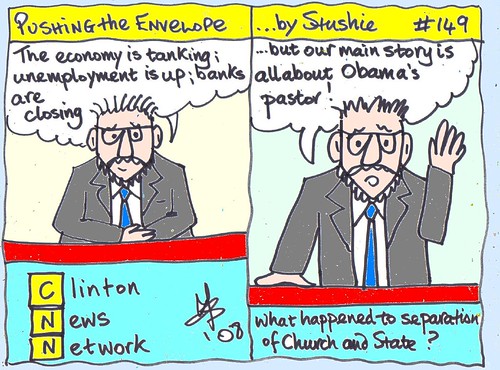
The more common translation of this phrase is there should always be a “separation between church and state.” History proves that Religion has always played a large role in the political sphere. America has almost always had a Christian as a President and that is not a coincidence. We as American citizens can claim that there is a separation between the two but clearly there is not a distinct separation. The line between the two has become blurred and religion has inherently become a societal factor in America. Religion has been an influence on American’s when it comes to Presidential candidates, Stem-Cell research, abortion issues, and same sex marriage laws. These policies are a part of our national politics and with the blurred line of church and state, we have developed some dilemmas in our political sphere.
In regards to the recent election, Obama had several issues around his religious orientation that lead to other harsh allegations. "I've been to the same church, the same Christian church, for almost 20 years," Obama said, according to MSNBC on January 21, 2008. "I was sworn in with my hand on the family Bible. Whenever I'm in the United States Senate, I pledge allegiance to the flag of the United States of America. So if you get some silly e-mail ... send it back to whoever sent it and tell them this is all crazy. Educate."
Religion also played a large role in the deciding factor on Stem-Cell research in America. According to Pew Research in 2005, roughly half (52%) of opponents to Stem-Cell research say their religious beliefs are the biggest influence on their thinking, while 13% cite what they have seen or read in the media and 12% mention their education. This is proof that religion, whether we try to deny it or not, plays a huge role in people’s thoughts and concern about politics and the way of life in our country. The Pew Research also stated that, “Conservative Republican opponents are especially likely (70%) to cite religion as their main influence, as are evangelical Protestant opponents (69%).” However, on the other hand of this survey, “31% of supporters for Stem-Cell research say the biggest influence on their thinking is the media, and 28% mention their education. Just 7% say religion is the most important influence. College graduates (44%) who favor the research are particularly likely to name education as their primary influence, as are pro-research liberal Democrats (43%).” Religion plays a role in both sides, more so in the opposition of these politics but nonetheless, religion still remains to be a deciding factor for some Americans in political views. With the blurred separation of church and state, people’s religious beliefs have continuously affected their views on political matters (Read more at: http://pewforum.org/docs/?DocID=145).
Subscribe to:
Posts (Atom)