The constitution states, "Congress shall make no law respecting an establishment of religion, or prohibiting the free exercise thereof."(http://www.allabouthistory.org/separation-of-church-and-state.htm)
The more common translation of this phrase is there should always be a “separation between church and state.” History proves that Religion has always played a large role in the political sphere. America has almost always had a Christian as a President and that is not a coincidence. We as American citizens can claim that there is a separation between the two but clearly there is not a distinct separation. The line between the two has become blurred and religion has inherently become a societal factor in America. Religion has been an influence on American’s when it comes to Presidential candidates, Stem-Cell research, abortion issues, and same sex marriage laws. These policies are a part of our national politics and with the blurred line of church and state, we have developed some dilemmas in our political sphere.
In regards to the recent election, Obama had several issues around his religious orientation that lead to other harsh allegations. "I've been to the same church, the same Christian church, for almost 20 years," Obama said, according to MSNBC on January 21, 2008. "I was sworn in with my hand on the family Bible. Whenever I'm in the United States Senate, I pledge allegiance to the flag of the United States of America. So if you get some silly e-mail ... send it back to whoever sent it and tell them this is all crazy. Educate."
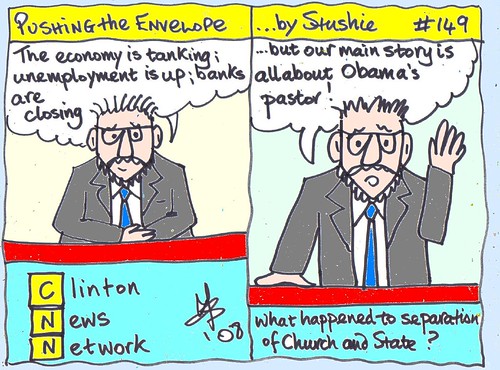
Barrack Obama had to make some corrections during his campaign in 2008 against the allegations that he was a Muslim terrorist in disguise. There was a popular mass email going around about Obama being a Muslim terrorist and swore in to the Senate on the Quran and turns his back on the flag during the pledge of allegiance. This was a concern wrapped into the 9/11 terrorists attacks in New York City connecting Obama with the attack. (Read more at http://www.msnbc.msn.com/id/22767392/).
To be quite honest, I received several of these emails during the 2008 campaign from a variety of people. Political Rhetoric played a big role in these emails on Obama bashing; “terrorist”, “anti American”, “Muslim”… terms a Presidential Candidate does not want to see written or spoken about him. Additionally, these terms evoked fear in some Americans about the religious orientation of Obama. These allegations set Obama back for some time, having to call upon his pastor of 20 years to support him to get back on track of addressing his actual politics, which in return ended up being another issue in itself as we all remember I am sure.
Religion also played a large role in the deciding factor on Stem-Cell research in America. According to Pew Research in 2005, roughly half (52%) of opponents to Stem-Cell research say their religious beliefs are the biggest influence on their thinking, while 13% cite what they have seen or read in the media and 12% mention their education. This is proof that religion, whether we try to deny it or not, plays a huge role in people’s thoughts and concern about politics and the way of life in our country. The Pew Research also stated that, “Conservative Republican opponents are especially likely (70%) to cite religion as their main influence, as are evangelical Protestant opponents (69%).” However, on the other hand of this survey, “31% of supporters for Stem-Cell research say the biggest influence on their thinking is the media, and 28% mention their education. Just 7% say religion is the most important influence. College graduates (44%) who favor the research are particularly likely to name education as their primary influence, as are pro-research liberal Democrats (43%).” Religion plays a role in both sides, more so in the opposition of these politics but nonetheless, religion still remains to be a deciding factor for some Americans in political views. With the blurred separation of church and state, people’s religious beliefs have continuously affected their views on political matters (Read more at: http://pewforum.org/docs/?DocID=145).
When it comes to the abortion debate, due to “separation of church and state” the United States Government has not been able to make abortions illegal or legal due to religious interference. It has been such a huge debate because it’s not only religious factors that influences peoples’ beliefs but morality and practically plays a part as well. Ethics and morality inevitably relate, in some form, back to religion and upbringing, therefore, religion will have some influence on the issue. When people think morally about the issue of abortion, I am sure no one would condone “killing” and essentially that is what abortions are thought to do. Granted, there are many factors that go along with that but in the broad scheme of things, morally, that is the issue behind abortion. Other moral issues that go along with abortion include: Is it moral to kill a baby for the sake of the mother’s life? Is it moral to kill a baby after rape? Does an unborn fetus have rights? Is an unborn fetus considered a living creature? These are all moral questions that people find hard to answer. American government could not possibly answer these questions for citizens either, hence the morality dilemma. Morality is not something that has a strict definition; to each their own. Morality relates back to religion and with religion being an influence, this is another example of how religion and state/federal laws are not entirely disconnected.
Another huge issue recently in America is the debate over legalizing same sex marriage. The biggest counter arguments that I have come across in my research in my past years in college regarding same sex marriage has been the issue of marriage being “sacred” and “traditional”, that same sex marriage is “against God’s will”, and “God intended marriage to be for procreation.” The only factors and counter arguments against legalizing same sex marriage has to do with “God’s plan,” thus referring back to religion. On the flip side, no government has suggested that any religious groups be forced to perform and recognize gay marriages and that proves that the government attempts to create a line between the two. However, there are obviously some conflicting views about legalizing same sex marriage on the basis of religious views and that is not supporting the “separation of church and state.”
If the “separation of church and state” means anything, it must include the idea that people cannot be forced by the government to live according to the commands of others’ religion. Issues such as what religious upbringing a Presidential candidate has, whether stem-cell research should be allowed or not, whether abortion should be illegal or legal, or whether people of the same sex should be able to join in the commitment of matrimony, clearly draw on religious beliefs. In actuality, according to the Constitution, religion and church teachings should not even play a factor in the judicial system. The blur between the two, church and state, has developed several predicaments in regards to making laws. The government system will continue to reach impasses until the fine line between church and state is noticeably established. Evidently, the separation of church and state is not an exact disconnect because one way or another, religion will influence the views of American citizens.

I really enjoyed your blog, you challenged people to question themselves and contrasted some very controversial issues in order to prove your thesis. The separation of church and state is an idea that I personally find to be impossible just because I feel that religious influence is deeply rooted in our society. Many Americans identify with our societies christian faith and absolutely let this faith influence their political participation and decisions. I think you put a lot of research into your topics, for example I had no idea that 52% of voters oppose stem cell research because of their religious values! This really just demonstrates the power of religious rhetoric and persuasion. However I feel like the rejection of an issue like same-sex marriage can be moved by religious connotations, but mostly it deals with the difference between federal and state policies. Thanks for the food for thought!
ReplyDeleteI think this is a great take on separation between church and state. You touched on tons of great information which I really enjoyed reading. It seems as though it might be impossible to have complete separation between church and state. Like you said, peoples religious beliefs will always effect how they vote, and what they stand for. On the same note, we live in a free country, people should be able to make their own choices. My personal opinion is that if a women wants to have an obortion, who is the government to tell her she can't? If a gay couple wants to legally be bound to each other, who has the right to tell them that they can't? Great blog with tons of great research!
ReplyDelete